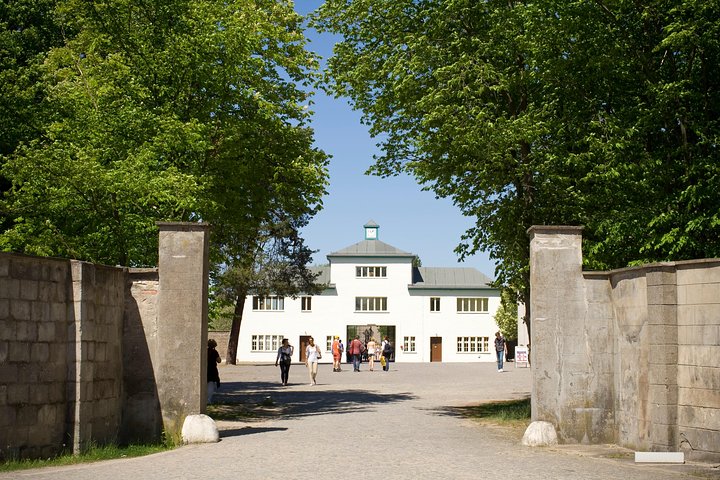


A Concentration Camp 35 Kilometres From Berlin
Sachsenhausen was a Nazi concentration camp located in Oranienburg, approximately 35 kilometres north of central Berlin. The camp operated from 1936 to 1945 and held over 200,000 prisoners — political opponents, Jews, Roma, Sinti, homosexuals, Jehovah’s Witnesses, prisoners of war, and others deemed enemies of the Nazi state. An estimated 50,000–100,000 people died at Sachsenhausen through execution, exhaustion, disease, medical experiments, and deliberate starvation.
Sachsenhausen was not an extermination camp (like Auschwitz-Birkenau) — it was a concentration camp, meaning its primary function was imprisonment and forced labour rather than industrialised mass murder. However, mass killings did occur at the site, including the execution of approximately 13,000 Soviet prisoners of war by shooting in 1941 using a purpose-built execution facility disguised as a medical examination room.
The camp has a particular significance in the concentration camp system: it served as the administrative headquarters and training centre for the entire SS concentration camp organisation. The SS officers who ran camps across Nazi-occupied Europe were trained at Sachsenhausen, and the camp’s layout — a triangular design intended to maximise surveillance from a single central point — became the template for other camps.
A visit to Sachsenhausen is the most significant Holocaust-related experience accessible from Berlin as a day trip. The site is preserved as a memorial and museum, with original buildings, reconstructed barracks, exhibition halls, and the remnants of the camp’s infrastructure — the walls, the watchtowers, the roll-call area, the execution trench, and Station Z (the extermination facility).
What You Will See
The entrance gate bears the inscription “Arbeit macht frei” (“Work sets you free”) — the cynical motto used at multiple concentration camps. Passing through the gate into the triangular camp interior is the moment where the site’s reality becomes physically present.
The roll-call area (Appellplatz) is a vast open space where prisoners were counted, often for hours, in all weather conditions. The SS guard tower (Tower A) at the apex of the triangle provided a clear line of sight across the entire camp — the design principle that made Sachsenhausen the “model camp.”
Barracks 38 and 39 have been reconstructed to show the living conditions — wooden bunks stacked three high, inadequate sanitation, and the degrading conditions that were deliberately designed to dehumanise the prisoners. The exhibitions inside document individual prisoner stories through photographs, documents, and personal objects.
Station Z — the execution and extermination area at the far end of the camp — contained a shooting facility (disguised as a height-measurement device), a gas chamber (installed in 1943), and a crematorium. The remains are preserved as a memorial. This is the most confronting section of the visit.
The infirmary and medical experimentation area documents the pseudo-medical experiments conducted on prisoners, including forced shoe-testing (prisoners were made to march for hours on different surfaces to test military boot soles) and other experiments that served no legitimate scientific purpose.
The Soviet Special Camp — after liberation in 1945, the Soviet occupation forces used Sachsenhausen as a prison camp (Special Camp No. 7) until 1950, holding approximately 60,000 political prisoners, of whom an estimated 12,000 died. This second chapter of the camp’s history is documented in a separate exhibition and adds a complex, uncomfortable layer to the site’s narrative.
Visiting Sachsenhausen From Berlin
Guided day tours from Berlin are the most common format — departing central Berlin by train (S-Bahn to Oranienburg, approximately 45 minutes) and spending 3–4 hours at the site with a specialist guide. The total excursion runs approximately 5–6 hours including transport. The guide provides the historical context, the personal stories, and the navigation that makes the large site comprehensible.
Independent visits are possible — the memorial is free to enter and open year-round. An audio guide is available. However, the site is large, the exhibitions are text-heavy (primarily in German and English), and the emotional weight of the material benefits significantly from a guide who can answer questions and provide human narration.
Practical Tips
This visit is emotionally demanding. Sachsenhausen is not a museum in the conventional sense — it is a place where tens of thousands of people suffered and died. Visitors should be prepared for confronting material and images. Allow yourself time to process the experience afterward.
The site is large and mostly outdoors. Wear comfortable, weather-appropriate shoes. The camp covers a significant area, and you will walk for 2–3 hours on gravel paths and uneven ground. In winter, the exposed, open site is cold. In summer, there is limited shade. Bring water and appropriate clothing.
Photography is permitted. Respectful, documentary photography is appropriate. Selfies, posed photographs, and casual social media photography at a memorial site where tens of thousands were murdered are not.
Allow at least 3 hours at the site. Two hours is the absolute minimum to see the main areas. Three to four hours with a guide gives you the full experience. The site is sufficiently large and the content sufficiently dense that rushing produces a superficial visit.
The S-Bahn to Oranienburg runs frequently. The train journey from central Berlin (Friedrichstrasse or Hauptbahnhof) takes approximately 45 minutes. From Oranienburg station, the walk to the camp entrance is approximately 20 minutes.
Frequently Asked Questions
How far is Sachsenhausen from Berlin?
Approximately 35 kilometres north of central Berlin. The S-Bahn train to Oranienburg takes approximately 45 minutes, plus a 20-minute walk from the station to the camp entrance. Guided tours include the train journey.
Is Sachsenhausen free to enter?
Yes. The memorial and museum are free. Audio guides are available for a small fee. Guided tours (booked through operators) have their own pricing.
How is Sachsenhausen different from Auschwitz?
Sachsenhausen was a concentration camp — primarily for imprisonment, forced labour, and persecution. Auschwitz-Birkenau was an extermination camp — built specifically for industrialised mass murder. Both were sites of enormous suffering and death, but their functions within the Nazi system were different. Sachsenhausen is the most significant camp accessible from Berlin. Auschwitz is in southern Poland, approximately 550 kilometres from Berlin.
Is Sachsenhausen suitable for children?
The material is extremely confronting. Children aged 14 and above with adequate preparation (prior discussion of the Holocaust and World War II) can engage meaningfully. Children under 12 are unlikely to understand the content and may be traumatised by the imagery and the physical environment. This is a decision for parents based on their knowledge of their child.
What should I know before visiting?
Understand the basic history of the Holocaust and Nazi concentration camps before arriving. The site’s exhibitions provide detailed information, but arriving with no context makes the visit overwhelming. A guided tour provides the necessary framework. Emotionally, prepare yourself for material that documents systematic cruelty and mass death — this is not an easy experience, and it is not intended to be.