




The City That Was Cut in Two
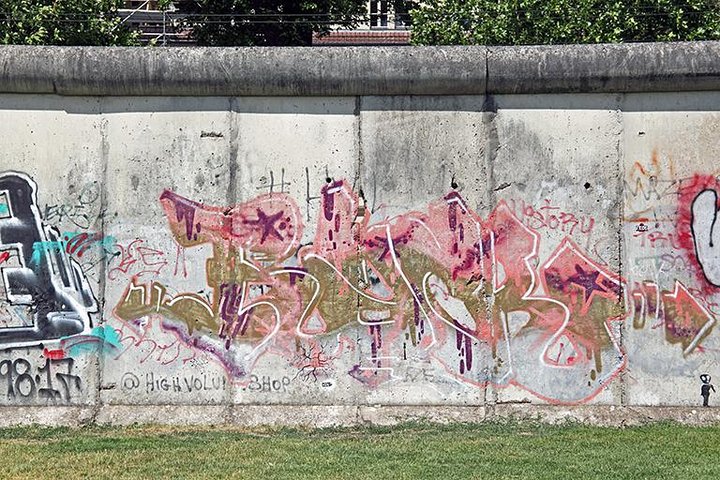
Berlin was the epicentre of the Cold War for 28 years. From the construction of the Berlin Wall on 13 August 1961 to its fall on 9 November 1989, the city was physically divided into West Berlin (an island of Western democracy surrounded by East Germany) and East Berlin (the capital of the German Democratic Republic, a Soviet-aligned communist state). The Wall was not a single barrier but a system of two concrete walls with a death strip between them — watchtowers, anti-vehicle trenches, and armed guards with orders to shoot anyone attempting to cross.
A Cold War and Berlin Wall tour takes you along the line where the Wall stood, to the crossing points where the tension was most acute, and through the remnants that survive — explaining not just what the Wall was but why it was built, how people lived on both sides, how they tried to escape (and often died in the attempt), and how the Wall’s fall in 1989 changed the world.
Key Sites
Checkpoint Charlie was the most famous crossing point between East and West Berlin — the point where American and Soviet tanks faced each other during the 1961 Berlin Crisis, where spy exchanges took place, and where the phrase “You are leaving the American sector” became one of the Cold War’s most recognisable images. The original guardhouse has been replaced by a replica, and the surrounding area is heavily commercialised, but a guided tour cuts through the tourist kitsch to explain what actually happened here and why it mattered.
The East Side Gallery is the longest surviving section of the Berlin Wall — 1.3 kilometres along the Spree River, painted by over 100 international artists in 1990 immediately after the Wall fell. The murals include Dmitri Vrubel’s “My God, Help Me to Survive This Deadly Love” (depicting the Brezhnev-Honecker kiss) and Birgit Kinder’s Trabant breaking through the Wall. The gallery is free, outdoor, and accessible at any time.
The Berlin Wall Memorial (Gedenkstätte Berliner Mauer) on Bernauer Strasse is the most comprehensive Wall site. It preserves a section of the complete Wall system — both walls, the death strip between them, and a watchtower — and documents the escapes, deaths, and personal stories of the division. The open-air exhibition, the documentation centre, and the Chapel of Reconciliation (built on the site of a church demolished to clear the death strip) make this the most historically informative Wall site in Berlin.
The DDR Museum (Museum of the German Democratic Republic) is an interactive museum on the Spree waterfront documenting daily life in East Germany — the apartments, the consumer goods, the Trabant car, the surveillance state, and the compromises people made to live under a system that controlled almost every aspect of their existence. The museum is hands-on (you can sit in a reconstructed East German apartment, drive a Trabant simulator, and read Stasi surveillance files) and provides the human dimension of the Cold War that the memorial sites address in more abstract terms.
The Stasi Museum (Stasimuseum) in Lichtenberg occupies the former headquarters of the East German Ministry for State Security (Stasi) — the secret police that maintained one of the most extensive surveillance networks in history. The museum preserves the offices of Stasi director Erich Mielke exactly as they were, and the exhibition documents the surveillance methods, the informant networks, and the impact on East German citizens’ lives.
The Palace of Tears (Tränenpalast) at Friedrichstrasse station was the departure hall where East Berliners said goodbye to Western visitors returning across the border — a place of recurring emotional farewells that gave the building its name. The free exhibition documents the border crossing experience and the personal stories of separation.
The Wall’s Path Through the City
The Berlin Wall followed a 155-kilometre route around the entire perimeter of West Berlin. Within the city centre, the Wall’s path is marked by a double line of cobblestones embedded in the road and pavement surfaces — a subtle but continuous marker that you cross repeatedly while walking through Berlin without necessarily realising it. A Cold War walking tour traces sections of this line, explaining what was on each side, where the crossing points were, and where escape attempts succeeded or failed.
Practical Tips
The Wall sites are spread across the city. Unlike the Third Reich sites (concentrated in the centre), the Cold War sites are dispersed — Checkpoint Charlie in Mitte, the East Side Gallery in Friedrichshain, the Berlin Wall Memorial on Bernauer Strasse, the Stasi Museum in Lichtenberg. A comprehensive Cold War tour requires either a long walking tour (4–5 hours) or a vehicle-assisted tour.
The cobblestone line marking the Wall’s path is easy to miss. Without a guide pointing it out, you will walk over it repeatedly without noticing. Once you see it, you cannot unsee it — and the realisation that you are crossing the line where people were shot for trying to do the same thing is one of the tour’s most powerful moments.
The East Side Gallery is best visited early morning. By midday, the Gallery is crowded with tourists and the pavement is busy. Early morning gives you the murals with space to appreciate them.
Frequently Asked Questions
How much of the Berlin Wall is still standing?
Very little. The Wall was almost entirely demolished after 1989. The longest remaining section is the East Side Gallery (1.3 kilometres). The Berlin Wall Memorial on Bernauer Strasse preserves a short section of the complete Wall system. Scattered fragments exist at other locations. A guide identifies where the Wall stood even where no physical trace remains.
How long is a Cold War walking tour?
Most run 3–4 hours. Combined Third Reich and Cold War tours run 5–6 hours. A comprehensive tour covering all major Cold War sites (including the Stasi Museum) requires a full day.
Is the Cold War tour suitable for children?
Children aged 10 and above can engage with the material, particularly the DDR Museum (which is interactive and hands-on). The escape stories and the human drama of the Wall engage older children. Younger children are unlikely to understand the political context.
What was daily life like in East Berlin?
The DDR Museum provides the most accessible answer to this question — reconstructed apartments, consumer goods, media, and the systems of control and conformity that shaped everyday existence. Life in East Germany was characterised by state surveillance, limited consumer choice, restricted travel, ideological conformity, and — for many people — a pragmatic adaptation to a system they could not leave.
Why was the Berlin Wall built?
By 1961, approximately 3.5 million East Germans had emigrated to the West, draining the GDR of skilled workers and embarrassing the communist regime. The Wall was built on 13 August 1961 to stop this exodus — physically trapping the East German population within the state. The official GDR justification was that the Wall was an “Anti-Fascist Protection Barrier” protecting East Germany from Western aggression — a claim that no one outside the Eastern Bloc believed.